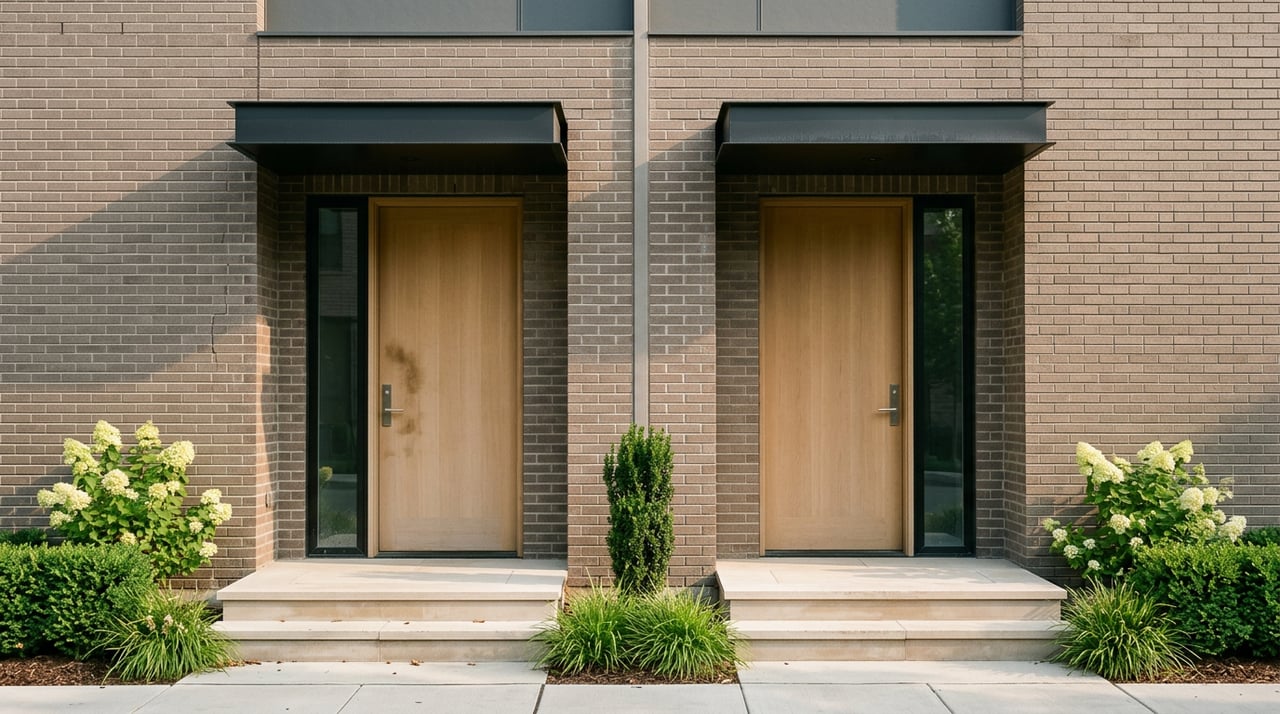
What $1M Reveals About the Palisades Park NJ Housing Market
July 16, 2026
July 16, 2026
Two listings, same week, both a short walk from Broad Avenue. One is an all-brick Cape on a 40 by 100 lot, asking in the mid six hundreds, built when Eisenhower was in office. The other is a 3,100 square foot new-construction side-by-side duplex half by PBS Builders, Inc., asking a shade over $1.4 million. On paper, the borough's median sale price sits neatly between them. In practice, no buyer is choosing between the two.
That is the thing to understand about Palisades Park pricing. The median is a blended average of two products that do not compete for the same buyer, do not appraise the same way, and do not exist in the same volume. The reason they coexist at all is a zoning decision the borough made in 1939 and has never really reversed.
Most Bergen County boroughs of similar size drew hard lines between single-family districts and multi-family districts. Palisades Park did not. According to the American Enterprise Institute's 2024 case study of the borough, when Palisades Park first adopted a zoning ordinance in 1939, it implemented combined one- and two-family districts for nearly the entire jurisdiction and created no zones that exclusively permit single-family detached homes. The 1959 Master Plan went further, explicitly noting that the code allowed conversion of any single-family home to two-family occupancy, and predicted duplexes would become the dominant type.
That prediction held. AEI's analysis of the 2018 five-year ACS shows fifty-one percent of the borough's housing stock has been built since 1969, and the visible development pattern since the 1980s has been methodical: teardown of a mid-century Cape or Colonial, replacement with a side-by-side duplex on the same lot. What looks like organic neighborhood turnover is really the exercise of a right written into the code decades ago.
The practical consequence for a buyer is that the detached, single-family, one-owner house is now the scarce product in Palisades Park. Colonials, Capes, and split-levels do not come to market often, and when they do they tend to trade in the roughly $500,000 to $750,000 range for the un-renovated stock, or well above $1 million when they sit on an oversized 50 by 125 or 75 by 100 lot that a builder can underwrite.
Here is the split a buyer sees on the ground in 2026, drawn from what is currently trading:
| Product | Typical size | Price band | Buyer profile |
|---|---|---|---|
| Older detached SFH (Cape, Colonial, split-level) | 1,200 to 1,800 sq ft, 40 by 100 lot common | ~$500K to $750K un-renovated; higher on oversized lots | End-user willing to renovate, or a builder assembling a teardown |
| New side-by-side duplex half or full 2-family | 3,000 to 3,300 sq ft per side, 3 to 4 bedrooms, 3.5 baths | ~$1.0M to $1.5M per side; full 2-families to $2.8M | Move-up owner-occupant, or a buy-and-hold investor holding one side and renting the other |
| Attached townhome / half-duplex | 1,700 to 2,000 sq ft, 3BR / 3.5 bath | ~$599K to $1.4M | Commuter, right-sizer, first move-up |
| Condo in an elevator building | 900 to 1,500 sq ft | Wide range, typically well below the borough median | Commuter, investor |
Now overlay the reported numbers. Redfin's data for zip 07650 for the three months ending May 2026 shows a median sale price of roughly $1.0 million at $508 per square foot, with days on market at 79 versus 121 the prior year. Movoto's February 2026 read put closed sales at a $1.045 million median across 32 transactions. Redfin's September 2025 snapshot had the borough median at $999,000, up 10.1 percent year over year, at $448 per square foot. Zillow's ZHVI, which blends every housing type in a single index, sits materially lower at roughly $797,000 as of April 2026, because it is weighted by the large stock of older detached and condo units the transaction median under-represents.
Read those numbers together and the story is not "prices went up ten percent." The story is that transaction volume is skewing toward the new-build side of the market. When a $1.4 million duplex half closes and an un-renovated Cape sits, the median moves. The homes themselves have not repriced.
The uniformity of new Palisades Park duplexes is not a stylistic accident. It is what the ordinance requires. Article III of the borough's zoning code, which is public on eCode360, sets specific ceilings and floors that shape every new two-family:
Those five constraints, combined, explain why the new-construction product in Palisades Park all reads roughly the same from the curb: three stories to get the square footage above a capped footprint, a tall pitched roof to meet the 4/12 minimum, a driveway apron wide enough to park four cars in front of a two-bay garage. When a listing describes a 3,100 square foot side per unit with 3.5 baths and a mirrored layout, the ordinance is doing most of the design work.
For a buyer, the numbers to price against are the ones you can verify against the code. If a duplex half advertises a footprint at or near 2,500 square feet, the builder maxed the envelope. If the garage count is short, the plan is either legacy or non-conforming and worth a call to the construction office before the offer.
In December 2024, following six builder's remedy lawsuits and a ruling by Judge Christine Farrington that invalidated the prior fair-share plan, the Palisades Park Borough Council adopted an ordinance permitting accessory dwelling units in one- and two-family homes. The parameters, as written into Chapter 300, cap ADU living area at forty percent of the primary dwelling up to 800 square feet, require a minimum of 300 square feet, and permit no more than two bedrooms and three rooms excluding kitchen and bath. In a two-family, the primary domicile of the owner must be one of the two dwelling units or the ADU itself, and the owner must file an annual affidavit of continued compliance every January.
For a buyer evaluating a duplex as a hold, the ADU rule quietly changes the math. A legally permitted ADU in one side of a two-family is a third income stream on the same tax lot, subject to the owner-occupancy requirement. That is a different underwrite than a strict two-family, and the ordinance is new enough that most comps do not yet reflect it.
Three things follow from all of the above, and none of them are visible on a portal.
First, ignore the borough-level median when you are shopping. Ask what the median is for the specific product you want. The Cape on a 40 by 100 lot and the new PBS Builders duplex half are pricing off different comp sets, different appraiser mindsets, and different buyer pools. A single median is not the number you are trading against.
Second, on any older detached home, read the lot before the house. A 50 by 125 or 75 by 100 lot in Palisades Park has a second bidder built in, because a builder can underwrite it as a teardown for a two-family. That floor is what keeps un-renovated SFH prices from softening the way they might in a strictly single-family town. When you write an offer on a Cape, you are competing with a spreadsheet, not just another family.
Third, on any new-construction two-family, verify the bulk. The footprint, the garage count, the driveway dimensions, and the ADU compliance file, if there is one, are all knowable before you go under contract. Builders operating in the borough at scale, including PBS Builders, Inc. and Technocraft Construction, tend to build to the envelope, but resale duplexes from earlier cycles sometimes do not, and that gap surfaces during a lender's appraisal review rather than at the offer.
Is Palisades Park a buyer's or seller's market in mid-2026? The answer depends on which product. New-construction duplex halves in the $1.0 to $1.5 million band are moving on a shorter timeline than the borough's roughly 79-day zip-level average for the three months ending May 2026. Older detached homes without a builder-grade lot sit longer.
Why is Zillow's home value so much lower than the reported sale median? Because Zillow's ZHVI is weighted across the entire housing stock, including condos and older detached homes that trade infrequently. The sale median reflects what actually closed, which in 2026 is heavily new-build.
Can I still find a detached single-family home in Palisades Park? Yes, but treat it as a lot as much as a house. The scarcity is structural, not cyclical, because the zoning has never protected single-family-only blocks.
If you are weighing Palisades Park against Cliffside Park, Leonia, Fort Lee, or Edgewater and want the comp set that actually matches the product you are shopping, Sara Shin Select reads the borough one lot at a time. Let's connect.
Whether it’s a home, warehouse, or medical building, Sara knows how to showcase properties at their highest value.